Social Stories

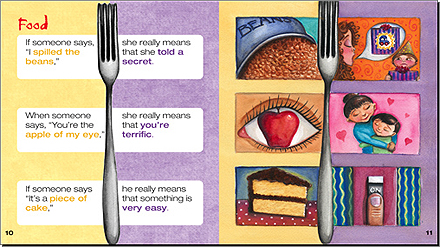
Social stories are often used to explain the intricacies of social interaction and other abstractions to autistic people. They look a lot like a comic book; rather than using complicated words and thus the inevitable abstractions, often beyond the autistic mind, they use pictures and sometimes text to explain a concept.

A good example of a typical social story is the image to the left, developed to explain some simple similes for autistic children. Often, parents of autistic children will have ready-made images for various purposes, from brushing your teeth in the morning to welcoming guests to the house in a proper manner. Social stories can be an excellent, often invaluable, tool, and have saved the day for probably countless families with kids on the spectrum.

Jessica Kingsley Publishers, a company specializing in part on Asperger/autism literature, publishes a sizable portion of the available books on autism spectrum disorders, so it came as no big surprise to me to find Revealing the Hidden Social Code by Carol Gray prominently displayed. The book promises to explain “key elements of Social StoriesTM, review the guidelines for writing them, and help writers to structure and develop their stories”, and indeed, it would have been one of the more authoritative guides on the topic since Carol Gray is the originator of the concept, had it not been for a little detail.

TM.

Everywhere, those two letters. T and M. And Social Stories, capitalized. Jessica Kingsley Publishers or Carol Gray, or both, regard the concept as trademarked, and so, everywhere where the two words Social and Stories are mentioned in each other’s immediate vicinity, the letters T and M follow, superscripted. Bla bla Social StoriesTM bla bla bla bla Social StoriesTM bla bla. Bla bla bla bla Social StoriesTM bla bla bla Social StoriesTM bla. Social StoriesTM bla bla bla bla bla.

See what I mean? Once you’ve noticed, it’s impossible to not see it. See how those two letters stand out, see how they destroy whatever context the author wished to dwell in? You can’t not see it.

So, for me at least, it’s now impossible to buy that book because I’m afraid I’ll learn not about social stories as such, but about how important it is to preserve your questionable trademark, no matter the cost.

Blogger in Beta

Oh, and in addition to upgrading to Iceweasel, I’ve also taken the leap to the new Blogger. It’s still in beta, but I’ve already noticed significantly faster editing and publishing. There’s a seemingly nifty layout function that goes beyond static CSS hacking, but I’ve not dared to try my hand on it yet.

A possible downside is that instead of a separate Blogger logon, they’ve integrated it with memberships and stuff. I’m not sure I like that, since it would appear that to have multiple Blogger accounts, I need a distinct email address for each and every one. (Why would I want that? Glad you asked; if I want to use and display different personal profiles, that’s what ‘ll need.)

So all I need now for my Google-induced happiness is a GMail account. But that’s not yet in widespread release so I guess I’ll just have to wait.

The MS Windows Vista EULA

Microsoft’s version of the brave, new world was never more apparent than in the Windows Vista EULA:

You may not work around any technical limitations in the software.

In other words, you’re prohibited from downloading and installing any patch or driver to your shiny new Windows Vista OS, unless the patch or driver is provided by Microsoft. Where do you want to go today? Me, I want to run away screaming.

I think I’ll stick to Debian GNU/Linux, for now.

Iceweasel in Debian

Long time no blog. Shocking as it may seem, I’ve not blogged since September. I’m sure you’ve all missed me.

Anyway, here’s why I blogged today. To put it simply, the Mozilla Foundation uses a trademarked Firefox logo that Debian team cannot distribute with its upcoming Etch release of the Debian OS, and therefore decided to rename the browser Iceweasel. The current license (of the logo) does not allow the reselling of software that includes the Firefox logo, so the renaming was the only option available to the Debian team if they wanted to distribute the browser. (For those of you not in the know, Debian is free software, and you can do whatever you want with the OS, including reselling it for a hefty sum of money.)

Unfortunately, Debian’s taking a lot of heat for the move. The decision to let Debian remain free and untainted by non-free licenses is called anything from “lame” to “disruptive”, and people are arguing that Debian’s strict license policy is hurting the open source movement since Firefox is its flagship product, soon to run on every desktop there is. And the policy is supposedly extra dangerous now, when Microsoft finally decided to upgrade Internet Explorer.

Unfortunately, people are missing the point. This is what open source really is about. The whole development model is about the freedom to do whatever you want with the software, including reselling it. It’s the “free” part that enables fast development, quick and efficient bug tracking, and new versions as fast as you can type apt-get.

Don’t let the open source ideals get lost because of some stupid image that will be changed and forgotten in a few version bumps, anyway.

No Viruses Right Now, Please

ClamAV, my virus hunter for Linux, stopped working today, after an unfortunate update of it and LSB Base (“Linux Standard Base”). Therefore, please don’t send any viruses my way until the fix is in place (the updates are supposed to be uploaded within the next few days; have a look at the bug report).

Weird XMetaL Bug in Wine

Up to, and including, wine 0.9.15-1, my installation of XMetaL crashes if I double-click somewhere in the writing area… I wonder if this is because of the reimplementation of the Internet Explorer Active X APIs in wine? I think I have to find a way to continue using Internet Explorer in wine, for now. Or downgrade to 0.9.11-1.

By the way, Internet Explorer doesn’t start in wine 0.9.15-1 but you knew that, didn’t you?